Thursday, October 24, 2013
The Bernal Sphere
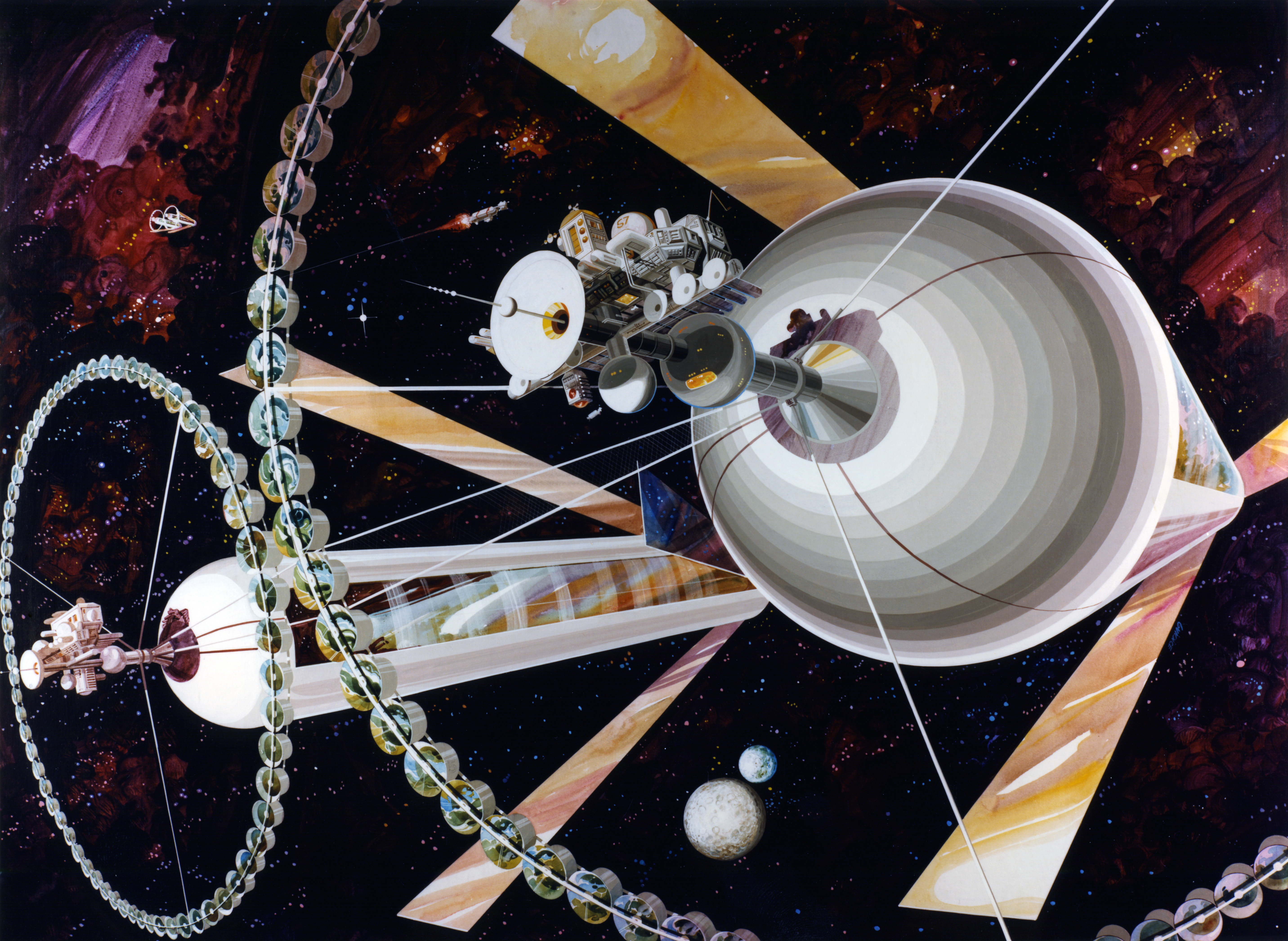
The Bernal Sphere was first proposed by John Desmond Bernal in 1929. The original description of the design was a hollow, spherical shell filled with air. In 1976 Dr. Gerard K. O'Neill proposed a new and improved version of the colony. He called it Island One. The entire thing is spinning really fast to make a force equivalent to one G, or one Earth gravity. The closer to the center that you get, however, the less gravity there is. There is a window going around the equatorial zone that is right next to a mirror. This mirror reflects sunlight in to produce a false sense of daylight. There are small Stanford Taurus' rotating around the tips of the Colony that are used for agricultural purposes; supplying food for the colony. Massive superconducting solar panels produce all of the energy for the colony. A later version of the colony can support a lot more people. All in all, the colony could be a great alternative to our current situation. All of the colonies could. Thanks, Aidan.

Friday, October 11, 2013
Collections
Many Sci-fi fans love to collect things from their favorite show. These collections can range from trading cards to action figures to ship models to Lego sets to posters to lunch boxes and beyond. A Star Trek fan might collect a Captain Picard action figure or a Enterprise model. A Star Wars fan might collect a Luke Skywalker action figure or a Death Star model. I, for one, have many action figures, and a Lego set of at least one ship from every Star Wars navy. Collecting can be a lot of fun, but if you let it take up to much of your time or money, it will wreck you. You have to spend the right amount of time and money for you. If you asked me if you should start collecting, I would tell you the honest truth. I would tell you that it's your choice, and that you should just follow your gut.
Wednesday, October 2, 2013
The Stanford Taurus
The Stanford Torus is another space colony design proposed by professors at Stanford University. It consists of a wheel very similar to a bike wheel that spins indefinitely with enough speed to create 1 g. The entire wheel is hollow. In the outermost part of the inside of the wheel is one continuous strip of living space. The innermost part of the wheel is a massive window. There is another piece other than the main wheel. This piece beams a beam of light into the center of the big wheel, where it bounces off of mirrors to fly into the window to simulate sunlight inside of the colony. The colony is designed to accommodate 10,000 people comfortably. Now that you know the facts, imagine what you'd do with a Torus if you had access to one. Tell me in the comments. Thanks, Aidan.

Wednesday, September 25, 2013
Space Colonies: The O'Neill Cylinder
The O'Neill Cylinder is a space colony designed by Gerard K. O'Neill that consists of a cylinder split into 6 parts. 3 of the 6 of these parts are pieces of land. The other 3 are windows. The entire cylinder is facing the sun. The windows have mirrors tilted away from the cylinder at 45 degree angles to let sunlight into the cylinder. The cylinder is always spinning fast enough to create the feeling of 1 g on the inside. Each cylinder can hold about 1,000,000 people sustainably. If these cylinders were more than just designs, I believe that they could have the power to change the world. Thanks, Aidan.

Thursday, September 12, 2013
Concept Ships
Concept ships have been around as long as sci-fi has. In every sci-fi movie with a ship, that ship is a concept, whether based on another ship or not. Some are inspired by random, everyday objects, others spurred by the innermost reaches of the designers mind. Until recently those concept ships have mostly been in movies and kids drawings. But now blogs are sprouting up with new ships done digitally on someones home computer. There are other blogs and websites sprouting up to map the progress of sci-fi and create elaborate diagrams comparing different ships. All in all, concept ships are here, and I think that they're going to change the world around us in a big way. Thanks, Aidan.


Subscribe to:
Posts (Atom)